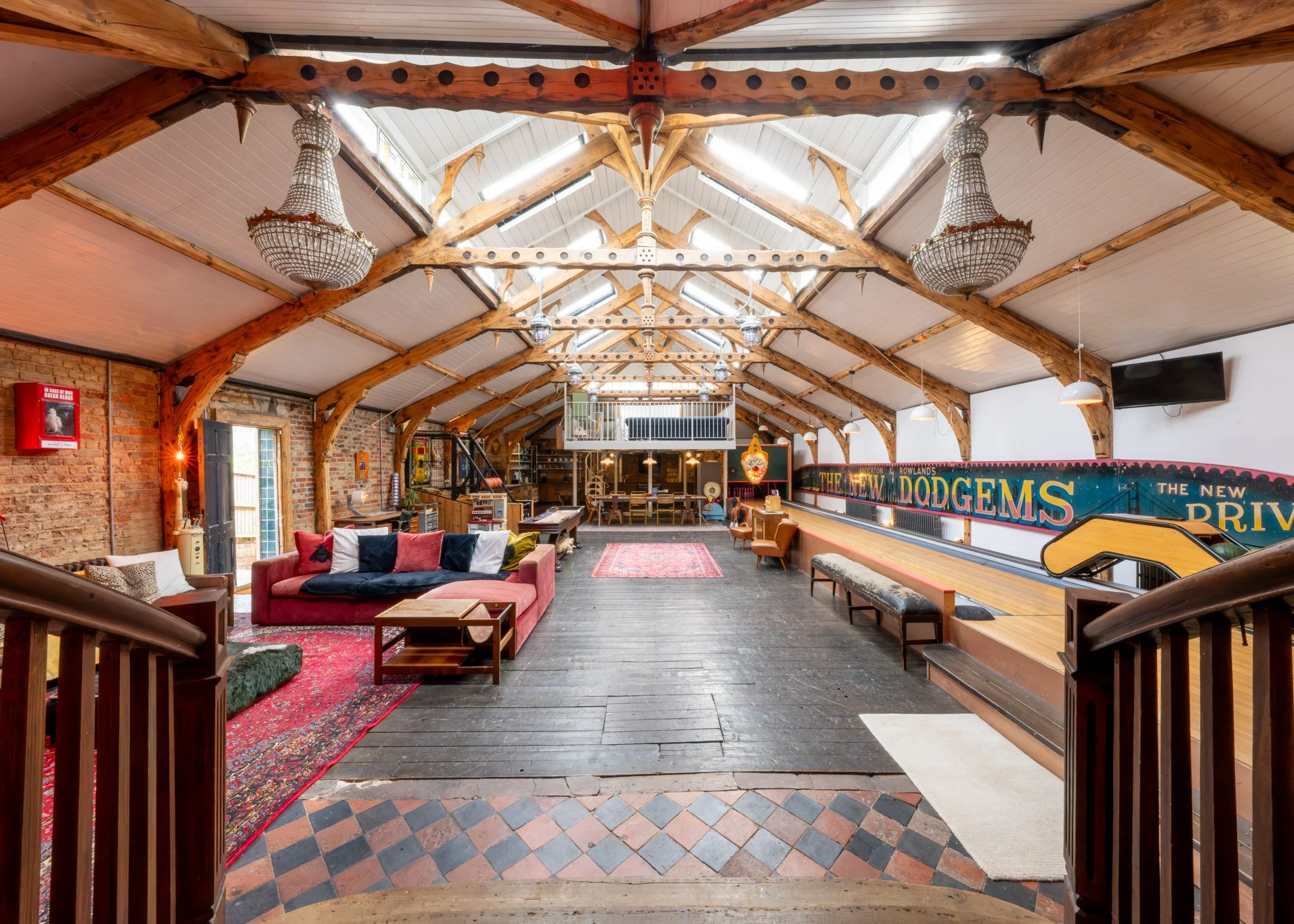
Songwriters book retreats for one reason: to write songs that wouldn’t otherwise get written. The usual suspects — the home studio, the shared apartment, the half-hour between label meetings — produce a certain kind of output. A retreat produces a different one. Three days in a room with a piano, a window, and people whose taste you trust will generate things a usual week won’t.
This guide is a practical map for UK-based songwriters and publishers planning a writing retreat: what to look for in a venue, how to think about retreats versus tracking, the kinds of retreats that actually produce songs, and a short list of UK regions worth considering.
What a writing retreat actually is
A writing retreat is a residential creative intensive where the output is the song — melody, top line, lyric, basic arrangement. It is not a recording session. You are not cutting final vocals or bouncing stems. You are generating material that will be tracked properly later, in a different space, with different equipment.
The distinction matters because it changes what you need from a venue. A retreat venue needs space for two or three people at an upright piano, a quiet room for solo writing, enough bedrooms to put five to eight people up comfortably, and a kitchen that lets the group eat together. It does not need a live room, control room, or isolation booths. Many retreat venues sold as “studio retreats” try to have it both ways; they usually do neither well.
A dedicated writing retreat works harder for songwriters than a half-studio-half-retreat hybrid.
What to look for in a retreat venue
Four things matter more than anything else:
Piano. An acoustic piano, or at minimum a weighted-key digital with a decent sound, is non-negotiable for most songwriters. A corner of a room with a guitar is fine too — the point is that the instrument is in the shared space, not tucked into a bedroom.
Separation. You need a main shared writing room for group work and at least one quiet spare room for solo writing or co-writes that need to split off. Open-plan everything doesn’t work for songwriters — someone always wants to mumble a melody on their own before bringing it back to the group.
A kitchen you can live in. The meals are the most important social moments of the retreat. Cheap takeaway every night kills a retreat in a day and a half. A kitchen that the group can cook in together — or a caterer who leaves food for you — keeps the energy steady.
Quiet. Traffic noise, construction, shared-wall neighbours — these kill a retreat. Coastal towns, rural villages, and the tail end of small cities tend to work better than central-city buildings.
Wi-Fi. Boring but required. Songwriters pull reference tracks, sync with publishers, send voice memos to collaborators. Unreliable broadband makes a retreat feel like camping in a bad way.
UK regions worth considering
Several UK regions host good retreat venues for songwriters. The main ones:
Sussex coast. St Leonards-on-Sea and Hastings run along the south coast about ninety minutes from London by train. The stretch is home to a number of large characterful houses available for whole-group hire, plus independent music venues and a small but serious creative community. The Bath House sits here; others in the region include larger Grade II listed houses further along the coast.
Cornwall. The usual poster-child region. Falmouth, St Ives, the Lizard — all have characterful retreat-scale properties. Travel from London adds a day each way; factor this into short retreats.
The Lake District. The classic walking-and-thinking region. Works best for retreats where the rhythm is solo-writing-then-group-review rather than top-line-session-style co-writes.
The Isle of Skye. Small number of genuine retreat properties; extreme weather, extreme light. Worth the trip for long-form retreats.
Wales. Both the Pembrokeshire coast and the Brecon Beacons host retreats with strong reputations in the songwriter community.
The Peak District. Accessible from both Manchester and Sheffield, an easy weekend format for Northern-based writers.
Travel time from London is worth being precise about. A three-day retreat with a six-hour round trip on either end has effectively two working days. The Sussex coast, the Peak District and the northern Home Counties score better on this math than the West Country and Wales.
Retreat structures that work
Three structures tend to produce the most consistent output:
The three-day sprint. Arrive Thursday evening, work Friday and Saturday, depart Sunday afternoon. Best for groups of three to five songwriters with a specific brief — an album’s worth of material, a commissioned project, a top-line push for a particular artist.
The five-day residential. Arrive Monday evening, write through the week, depart Saturday morning. Better for larger groups (six to nine writers), for mixed disciplines (topliners plus producers plus lyricists), and for projects where the material is still emerging at the start.
The seven-day writing block. Twice as long as a sprint, gives space for the second wind — the point around day four when the first ideas have been exhausted and something new surfaces. Usually reserved for single-artist projects or album-writing blocks.
Avoid the two-day retreat. Two nights is barely arrival plus one productive day; the group never settles. Likewise avoid ten-day retreats — in practice, they degrade into holiday by day seven.
Budget and cost structure
Retreat venue hire in the UK runs from around £400 to £800 per night for a whole-house rental that sleeps six to eleven, before catering, travel and any hired musicians. Five-night retreats for six people cost roughly £2,500 to £4,500 for the venue alone.
Catering is the next-biggest line. A caterer who leaves twice-daily food runs around £40 to £80 per head per day. Alternatively, one group member (or the retreat organiser) takes on the kitchen duty for the week — this doubles as a grounding ritual and cuts cost materially.
Travel is usually the cheapest line but the easiest to underestimate in time: see the travel-time point above.
How to pick a retreat venue
A short checklist that helps:
- Does the venue have an actual piano?
- Is there at least one quiet separation room?
- Is Wi-Fi solid enough for video calls and syncs?
- Can the group all eat together comfortably?
- How far is it, door to door, from your group’s base?
- Are there caterers near the venue, or kitchen infrastructure?
- Is the venue booked for whole-house hire, or are other guests coming and going?
The last point matters more than it sounds. Retreat venues that take split bookings (a group in the main house plus a group in the annexe, for example) kill the focus. Whole-house-only rentals are the only configuration that consistently works for writing retreats.
The thing no retreat can provide
Infrastructure is the easy part. The writers in the room are the hard part. A retreat is only as good as the group — a tight creative fit, mutual trust, complementary tastes, shared stakes. Venues and schedules shape the container; the people inside it decide whether the songs get written.
Book the right people first. Then book the right venue.
Songwriter-retreat FAQ
Common questions, answered.
Is The Bath House a recording studio?
No — The Bath House is a writing and creative retreat venue, not a recording studio. For proper tracking work we'd point you towards a different space. The house is designed to generate songs — top line, melody, lyric, arrangement sketch — in shared rooms with a piano, a kitchen and a quiet end of the house for solo work.
How many songwriters can The Bath House accommodate for a retreat?
Up to eleven guests across three bedrooms (one master, one double, one twin). Optimal retreat size for songwriters is four to eight writers plus one or two producers or publishers. Fewer than three is rarely worth the travel cost; more than nine starts to fragment the creative conversation.
How far is The Bath House from London?
Warrior Square station, ten minutes' walk from the property, runs direct to London Charing Cross in about an hour and forty minutes. By car, expect two hours via the A21. This makes the Sussex coast one of the easiest UK retreat regions to run from a London-based schedule.
Do you provide catering for retreats?
No in-house catering, but the kitchen is fully equipped for self-catering and we can introduce you to local caterers who leave twice-daily meals. Most retreats use a mix — lunch delivered, dinner cooked together. The cooking often becomes one of the grounding rituals of the retreat.
Enquire
Planning a writing retreat?
The retreats page has structures and sample weeks. The stay details cover bedrooms and amenities.
Enquire about a retreat